Treating osteoporosis
Osteoporosis is highly treatable. Two families of medicine — those that preserve bone and those that build it — are used in deliberate sequences to get high-risk patients to a safer bone density and keep them there. Here is how each works, who should start with what, and why the order matters.
Key takeaways
- Treating osteoporosis works — it lowers fracture risk substantially, and treating overt disease reduces cardiovascular events and mortality.
- Medicines are either antiresorptive (preserve bone) or anabolic (build bone). Anabolics act faster and produce larger gains, especially at the hip.
- For very-high-risk patients, guidelines now favor an anabolic-first strategy rather than a bisphosphonate for everyone.
- Sequence and maintenance matter: anabolic gains must be locked in afterward, and denosumab must never be stopped without a follow-on drug.
What this means for you
If your bones have become fragile, the goal is straightforward: reduce your chance of breaking one. For many people that means a well-chosen medicine, adequate calcium and vitamin D, and a plan to re-check that it's working. If you're at very high risk, the first drug we choose — and the order of what follows — can meaningfully change the outcome.
Who is treated, and who is monitored
Not everyone with low bone density needs medication. The decision follows risk:
- High and very-high risk patients — those with osteoporosis by T-score, a fragility fracture, or high FRAX probability — should be treated to prevent a first or recurrent fracture.
- Low-to-moderate risk patients are generally monitored and reassessed over time, with attention to calcium, vitamin D, exercise, and fall prevention (see Nutrition & Life).
Everyone — treated or not — should have adequate calcium and vitamin D, which is the foundation on which every osteoporosis medicine is built, not a treatment in itself for high-risk disease.
Antiresorptive therapies — preserving bone
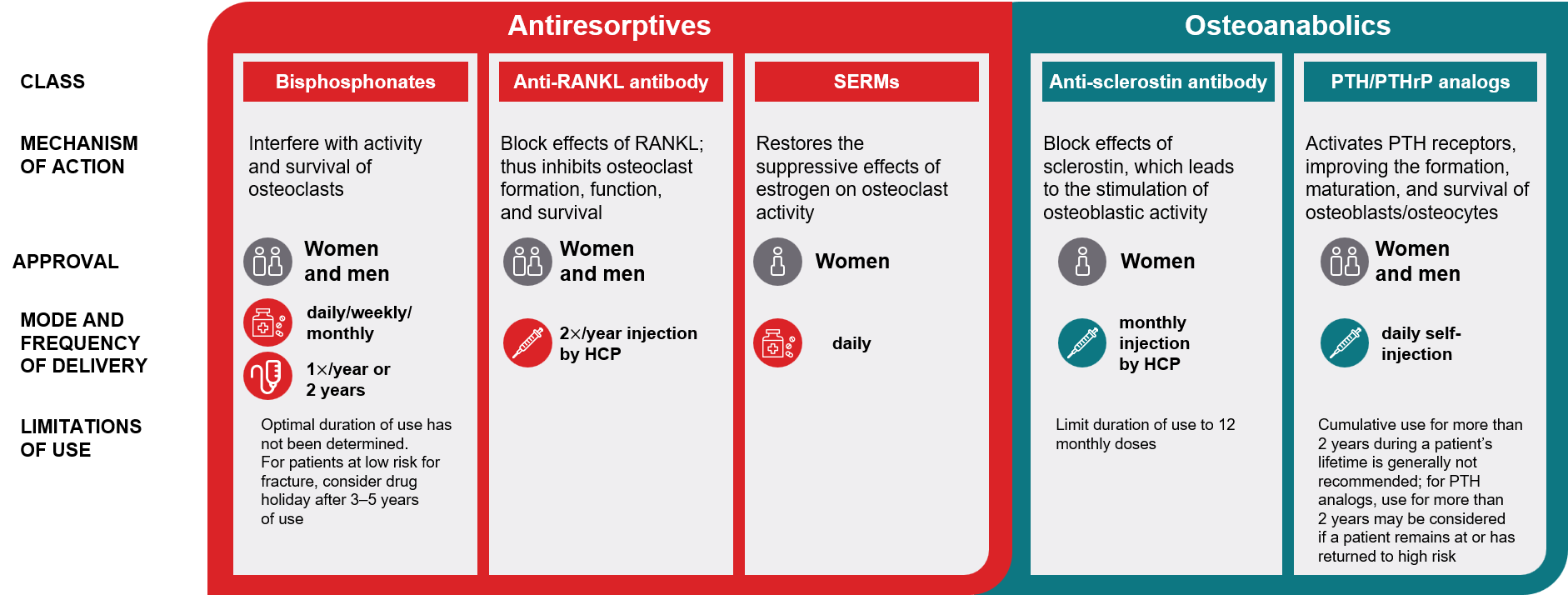
Antiresorptive drugs slow the osteoclasts that remove bone, tipping the remodeling balance back toward preservation. They are effective, widely available, and first-line for most patients at high (but not very high) risk.
Bisphosphonates (alendronate, risedronate, zoledronic acid, ibandronate)
Grade A · Guideline-supportedDenosumab (anti-RANKL antibody)
Grade A · Guideline-supportedEstrogen therapy & SERMs (e.g., raloxifene)
Grade B · Selected patientsAnabolic (bone-building) therapies
Anabolic agents do something antiresorptives cannot: they stimulate new bone formation, adding bone rather than just slowing its loss. Studies over the past decade show anabolic agents produce faster and larger reductions in fracture risk and gains in bone density than antiresorptives — and head-to-head trials in high-risk patients show they prevent fractures more effectively than bisphosphonates and denosumab. This is the "bone-building" case at the heart of modern high-risk care.
Teriparatide & abaloparatide (PTH / PTHrP analogs)
Grade A · Guideline-supportedRomosozumab (anti-sclerostin antibody)
Grade A · Guideline-supportedFor cliniciansChoosing among the anabolic agents
There are no head-to-head fracture-outcome trials among the three anabolics, and such studies are unlikely. All three increase bone strength and reduce fracture risk rapidly; romosozumab and the PTHrP analog abaloparatide tend to produce the greatest hip BMD gains. Selection is individualized to fracture pattern (vertebral vs. hip risk), cardiovascular history (favoring PTH/PTHrP analogs over romosozumab where cardiovascular risk is high), route/frequency preference, and coverage. Because the postmenopausal lifespan can be 30–40 years, most very-high-risk patients will use different agents at different points.
Goal-directed treatment & sequencing
The most important shift in osteoporosis care is moving from "same first drug for everyone" to a goal-directed, treat-to-target approach — the subject of the 2024 ASBMR/BHOF task force position statement. Three ideas drive it:
- Set a target. The bone-density level a patient reaches on treatment predicts their future fracture risk. Total-hip BMD is the most useful target because it predicts both vertebral and nonvertebral fractures; a T-score above −2.5 is a reasonable minimum goal for most.
- Match the first drug to the goal. Choose the initial therapy by how likely it is to reach the target in a reasonable time — which depends on the starting T-score. A patient far below target is unlikely to get there on a bisphosphonate alone and is better served starting with an anabolic.
- Order matters — anabolic first. Starting with an anabolic and then an antiresorptive produces greater bone-density gains, particularly at the hip, than the reverse order. The gains from an anabolic are lost if not followed by an antiresorptive to maintain them.
Anabolic-first sequencing for very-high-risk patients
Grade A · Guideline-supportedHow likely is a target to be reached? Analyses give concrete numbers. With denosumab, a woman starting with a total-hip T-score of −2.7 has about a 71% chance of reaching a T-score above −2.5 in three years; at −3.0 that falls to ~12%, and at −3.5 it is near zero — though longer treatment raises the odds. Anabolic agents reach targets from lower starting points more often. This is exactly the kind of estimate that should guide the first choice, not trial and error.
What we know
- Treating osteoporosis lowers fracture risk; treating overt disease lowers cardiovascular events and mortality.
- Anabolics build bone faster and larger than antiresorptives, especially at the hip.
- Anabolic-first sequencing and treat-to-target improve outcomes in high-risk patients.
What we don't know
- Which anabolic is best head-to-head for fracture outcomes (no such trials exist).
- The single optimal BMD target for every patient — it's individualized.
- The ideal very-long-term sequence across a 30–40-year postmenopausal lifespan.
Drug holidays & stopping treatment
Osteoporosis is lifelong, but not every drug is taken forever — and how a drug is stopped matters as much as how it's started.
- Bisphosphonates can allow a "drug holiday" after several years in appropriately selected lower-risk patients, because their effect lingers in bone. But it isn't indefinite: after stopping long-term alendronate, bone-turnover markers rise and BMD begins to fall within the first year, so patients on a holiday need continued monitoring and a plan to restart.
- Denosumab is different — it has no holiday. Stopping it (or even delaying a dose) causes rapid bone loss and a rebound in vertebral fracture risk, sometimes multiple fractures. If denosumab is discontinued, it must be followed by a bisphosphonate (or another agent) to prevent this.
- Anabolic courses are time-limited by design (~1–2 years) and are always followed by an antiresorptive to preserve the bone that was built.
When to call your doctor
- You've broken a bone — even from a minor fall — recently or in the past.
- You're due for a denosumab dose and haven't scheduled it, or you're considering stopping it.
- New thigh or groin pain on long-term bisphosphonate or denosumab (rare atypical femur fracture).
- Planning major dental surgery while on an antiresorptive.
- You started an anabolic and your ~2-year course is ending (you need a maintenance plan).
Questions to ask your doctor
- Am I high risk or very high risk — and does that change which drug I should start with?
- What bone-density target are we aiming for, and how likely is my treatment to reach it?
- Should I start with a bone-building drug rather than a bisphosphonate?
- What happens after this course ends — what maintains the gain?
- If I'm on denosumab, what's the plan so I never miss a dose or stop unsafely?
How we grade evidence. Every therapy carries a plain label — from established, guideline-supported care (A) through moderate (B) and conflicting (C) to experimental (D) and insufficient (E). A change in bone density or a laboratory marker is not the same as a demonstrated reduction in fractures, and we say which we mean.
Considering treatment — or unsure it's the right one?
We match the first therapy to your risk, set a target, and plan the sequence. Board-certified endocrinologists, straight answers.